Is the U.S. next?
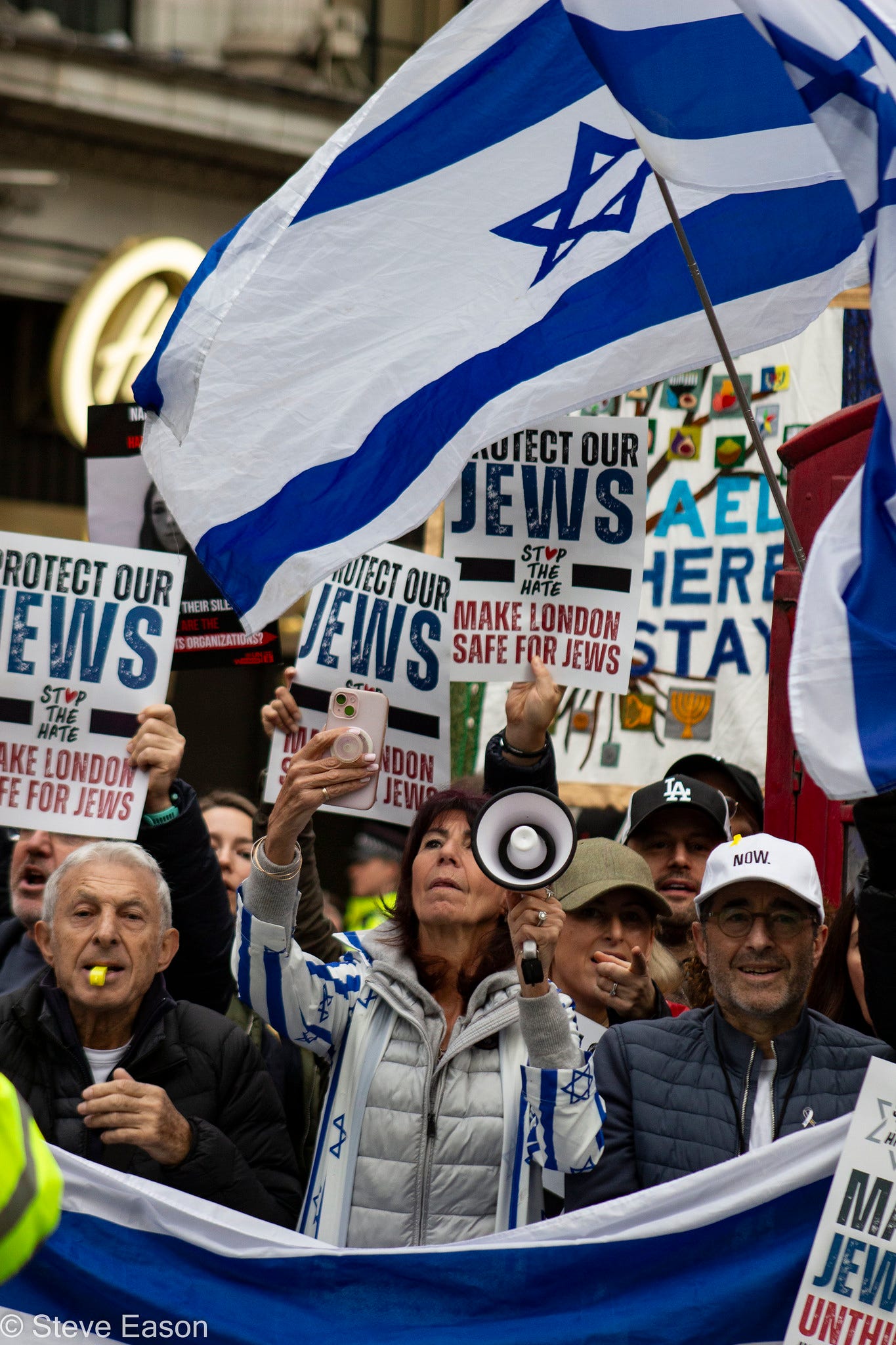
There are moments when a society crosses a line and everyone knows it, even if officials are still trying to find the right language for it. Britain appears to have crossed one of those lines.
This week, two Jewish men were stabbed in Golders Green, one of the most visibly Jewish neighborhoods in London. The victims, locally named as Shilome Rand, 34, and Moshe Shine, 76, were reportedly wearing traditional Orthodox Jewish clothing. They were treated at the scene and taken to hospital in stable condition. Police quickly declared the attack a terrorist incident.
A terrorist incident — not merely another ugly street crime in a big city. This was not just another hate incident to be filed away in a quarterly report, either — which would be bad enough. This was a terror investigation after two visibly Jewish men were attacked in a Jewish neighborhood.
And now Jonathan Hall KC, the British government’s independent reviewer of terrorism legislation, has said attacks on Jews in the UK have become “the biggest national security emergency” in almost a decade.
That is a remarkable statement. It should stop everyone cold.
Because what he is describing is not only a security problem. It is a civilizational problem. Britain, one of the great liberal democracies of the world, is now in a place where Jewish citizens are wondering whether they can live normal public lives.
Can they walk to synagogue?
Can they send their children to Jewish schools?
Can elderly Jewish men stand at a bus stop?
Can Orthodox Jews wear the clothes of their faith in public?
Can Jewish families simply be visibly Jewish without becoming targets?
Chief Rabbi Sir Ephraim Mirvis said the Golders Green attack proves that “if you are visibly Jewish, you’re not safe.” That is a devastating, disgraceful sentence. Not because it is dramatic, but because so many British Jews seem to recognize the truth of it.
And the government knows it too, even while trying to reassure people. Home Secretary Shabana Mahmood announced another £25 million for security around synagogues, schools, and Jewish community centers. More patrols. More protection. More guards. More hardening of ordinary Jewish life.
It is an indictment.
A free country should not require a security infrastructure around Jewish children, Jewish worshippers, Jewish ambulances, Jewish memorials, Jewish neighborhoods, and Jewish elderly people walking down the street. Once that becomes normal, something profound has already failed.
This is the part that too many people still do not want to face. Antisemitism in Britain did not merely spike after October 7 and then return to normal. It seems to have settled into the atmosphere. It is now a weather system. Part of a “new normal.”
Jewish institutions have been vandalized. Jewish neighborhoods have been threatened. Arson attacks have been investigated. Jewish people have been harassed, abused, and intimidated. And now, again, blood has been spilled.
The old liberal assumption was that Jews in Britain, Jews in America, Jews in the West generally, could be fully Jewish and fully public at the same time. They could wear a kippah. They could send their children to Hebrew school. They could attend synagogue. They could speak about antisemitism without being accused of manufacturing victimhood. They could support Israel, criticize Israel, ignore Israel, pray for Israel, or simply be Jewish without having every geopolitical grievance on earth dumped onto their doorstep.
That assumption is starting to look fragile.
And no, this does not mean every criticism of Israel is antisemitic. That has never been the serious argument. The serious argument is that anti-Israel rage has become one of the main languages through which antisemitism now expresses itself. A synagogue becomes “Israel.” A Jewish school becomes “Gaza.” A Jewish neighborhood becomes a battlefield in someone else’s religious fever dream. A man in Orthodox clothing becomes a symbol instead of a human being — a scapegoat. We all know what can happen next.
That is how societies become dangerous for Jews. It starts with slogans. Then vandalism. Then open threats. Then fires. Then knives.
And if this sounds far away, it should not.
Jews in New York City increasingly express versions of the same thing British Jews are now saying out loud. They are changing how they move through the city. They are thinking twice about visible signs of Jewish identity. They are more aware of who is nearby on the subway. They are more careful at protests, on campuses, near synagogues, even in neighborhoods where Jewish life has existed openly for generations.
The West has a bad habit of treating antisemitism as an old problem, safely locked in the past, rather than a living hatred that constantly adapts itself to whatever political vocabulary is available. In one era, Jews are accused of being rootless capitalists. In another, Bolsheviks. In another, globalists. In another, colonial oppressors.
What is happening in Britain should be understood as a warning. Not only to Britain, but to every Western country that still imagines this cannot happen here.
Because the real test is not whether officials condemn antisemitism after two men are stabbed. They will.
The test is whether the state can make public Jewish life safe again.
The test is whether police, prosecutors, schools, political leaders, media institutions, and civil society are willing to confront the ideological ecosystem that makes Jews feel hunted.
The test is whether decent people can say, without hedging and without immediately changing the subject, that Jewish citizens have the right to live openly as Jews.
Britain is now facing that test.
America may be next.
And if Jewish people in London, Manchester, or New York conclude that the safest thing to do is become less visible, then the antisemites have already won more than any free society should tolerate.
(Contributing writer, Brooke Bell)